Ernesto Neto at MFAH: SunForceOceanLife Review
Ernesto Neto turned crochet into a 6,000-pound sculpture you climb inside. His MFAH retrospective is unmissable.
You take off your shoes. You put on the museum-issued nonslip socks. You climb a ramp and step onto a surface that gives — soft plastic balls shifting under your weight, your body adjusting, your center of gravity suddenly uncertain. You are twelve feet in the air, inside a hand-crocheted labyrinth that weighs 6,000 pounds and is made from 309,000 feet of string. That's 58 miles. Fifty-eight miles of string, crocheted by hand, suspended from the ceiling of Cullinan Hall in the MFAH's Caroline Wiess Law Building, and you are walking through it in your socks.
This is Ernesto Neto's "SunForceOceanLife," and it is one of the most extraordinary things you can do in a museum anywhere in the country right now. It closes September 7. You should go.
The structure measures nearly 30 feet by 79 feet by 55 feet — dimensions that sound abstract until you're inside it and realize you can't see the walls of Cullinan Hall anymore. The woven pathways spiral outward from the center in vibrant yellows, greens, and oranges, with one point of entry and one point of exit. There is no map, no signage, no instructions beyond the ones your body provides. You walk forward. The balls shift. You lean into the crocheted walls, which flex and bounce. You round a curve and the light changes — filtered through the woven mesh, the gallery's overhead illumination becomes something warm and aquatic. Other visitors move along parallel paths, visible through the fabric but unreachable, their footsteps producing a soft collective percussion.
The piece was commissioned by the MFAH in 2019 and first shown in Houston in 2021. A team of a dozen people spends three weeks constructing it — sewing the hand-crocheted sections together, filling them with plastic balls, hoisting the finished structure to the ceiling. It is the largest crochet artwork this museum has ever hosted, and possibly the largest anyone has. Glasstire called it a work whose "precise forms remain mysterious and difficult to reconstruct in the mind's eye." That's exactly right. You can't photograph it in a way that communicates the experience. You have to climb in.
## The Grandmother
In 1994, Ernesto Neto asked his grandmother — "vovo Lia" — and her great-aunt — "tia Vera" — to teach him how to crochet. He was 30, already exhibiting internationally, already working with fabric and organic shapes. But crochet was something different: a domestic Brazilian craft, typically executed by women on a small, delicate scale, associated with doilies and blankets and the quiet labor of grandmothers. Neto took the technique and scaled it to architecture. He uses a style called "nozinhos" — a rustic Brazilian crochet made by poor communities — and finger crochet, which he teaches to groups in workshops around the world.
The gesture matters. Taking a craft from the domestic sphere and turning it into something that fills a museum hall is not ironic for Neto. It's not a commentary on high and low culture. It's a statement of belief: that the things grandmothers know are as powerful and as worthy of attention as anything in the canon. "I am wrapping air, making atmospheres physical," he said in 2000. The atmosphere he's wrapping in Cullinan Hall smells faintly of the plastic balls and the woven string, feels warm on your skin, and sounds like distant footsteps and the rustle of fabric. It is entirely, bodily present.
## The Amazon Connection
Since 2013, Neto has collaborated with the Huni Kuin, an indigenous nation of roughly 8,000 people in the Upper Amazon. He traveled into the Amazonian jungle to learn from them, and their collaboration produced "Aru Kuxipa" — Sacred Secret — incorporating Huni Kuin iconographic and ritual elements, including healing patterns called kenes, ayahuasca rites, and figures of the boa constrictor and jaguar. The Huni Kuin influence runs through "SunForceOceanLife" in ways that aren't immediately visible but become legible the longer you spend inside: the spiraling pathways echo cosmological patterns, the shifting underfoot evokes the instability of forest floors, and the enclosed warmth of the woven walls feels less like architecture and more like being held.
"SunForceOceanLife is about fire," Neto has said, "the vital energy that enables life on this planet. It unites the disciplines of art and culture with biology and cosmology; it directly engages the body as does a joyful dance or meditation, inviting us to relax, breathe, and uncouple our body from our conscious mind."
He was born in Rio de Janeiro in 1964. He represented Brazil at the 2001 Venice Biennale. He's shown at the Guggenheim Bilbao, MoMA, the Park Avenue Armory, the Hayward Gallery in London, and the Nasher Sculpture Center in Dallas. He draws from Brazilian Conceptualists Lygia Clark and Helio Oiticica, from Minimalism and Arte Povera. But none of that context prepares you for the sensation of walking through a building-sized crochet at twelve feet in the air while soft balls roll under your feet.
## Practical Information
You must be able to walk without assistance — the museum requires visitors to confirm this before entry. Shoes are not allowed; the museum provides nonslip socks. The pathway has no railings. It moves. If you're uncomfortable with heights or unsteady footing, you can view the piece from the gallery floor, where the underside of the structure is visible as a canopy of woven color overhead. That's beautiful too, but it's not the same.
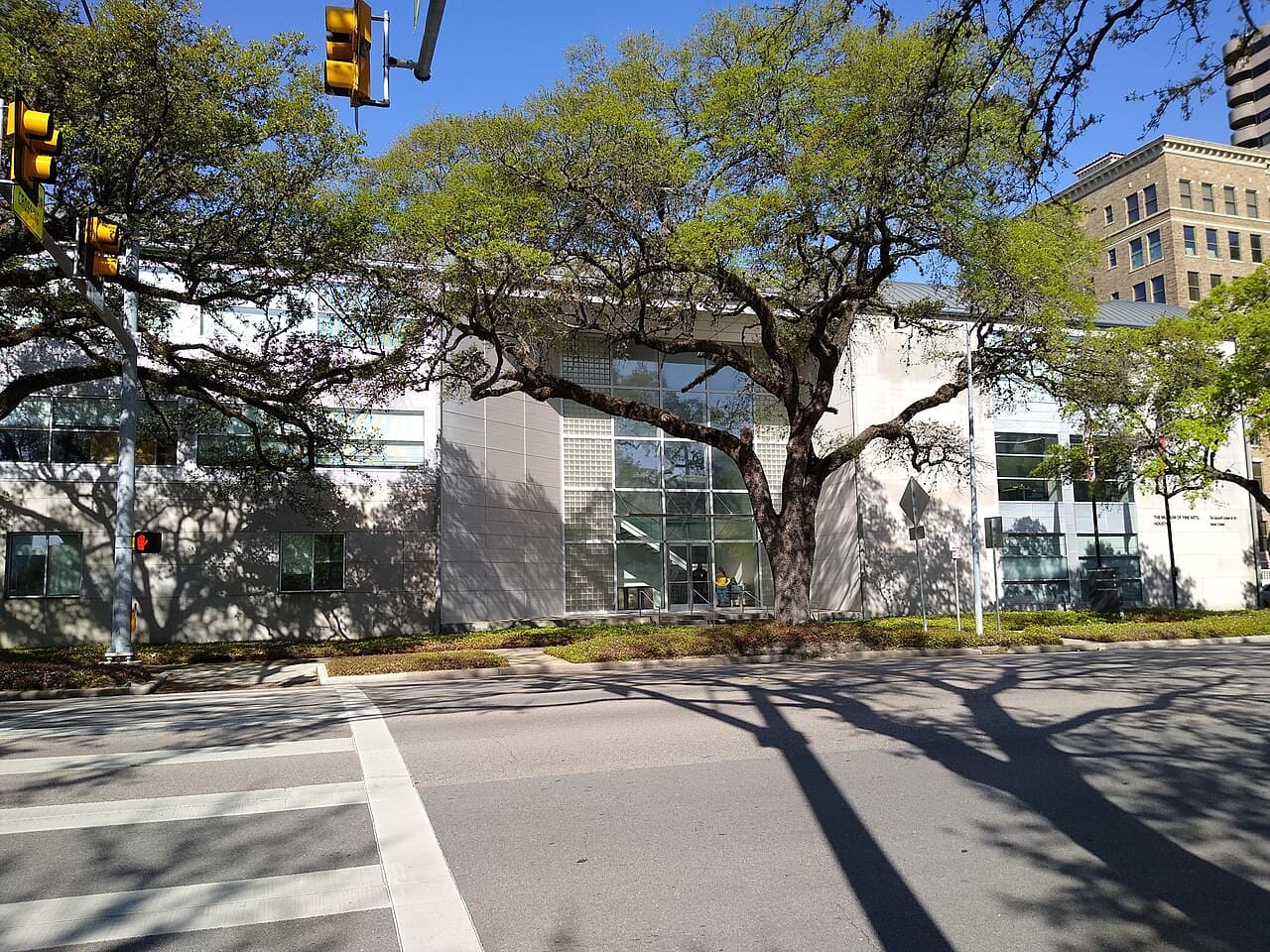
"SunForceOceanLife" is on view through September 7, 2026, in Cullinan Hall at the Museum of Fine Arts, Houston, 1001 Bissonnet Street. General admission applies ($19 adults, free for children 12 and under, free on Thursdays). While you're there: "Picasso–Klee–Matisse: Masterpieces from the Museum Berggruen" runs through September 13 in the same building, and Olga de Amaral's retrospective opens July 25. Two blockbusters and a suspended crochet labyrinth under one roof. The MFAH is having a summer.