Latinx Art in Texas: The Essential Guide
Texas art runs deeper than you think. Five cities, 800 Latin American masterworks, 53 murals, and stories no one is telling.
Larry D. Moore · CC BY 4.0
Texas is not where most people expect to find one of the most significant concentrations of Latinx art in the country. They expect New York, maybe Los Angeles, maybe Miami. But the infrastructure here — institutional, historical, and deeply rooted in community — is unmatched by any of those cities, and the argument isn't even close. The Museum of Fine Arts, Houston has over 800 acquired works of Latin American and Latino art. San Antonio has 53 murals across its Westside alone. Austin's Mexic-Arte Museum is building a $14 million expansion on Congress Avenue. And the artists — from a Vietnam veteran who lost his right arm and learned to paint left-handed to a San Antonio printmaker who designed an Absolut Vodka bottle — are making work that is as formally ambitious as anything in the American art world.
This is the essential guide. Hispanic Heritage Month runs September 15 through October 15, and if you're going to pay attention to Latinx art in Texas once a year, that's the time. But the art doesn't wait for a calendar. It's here year-round, and the scene is deeper than any single month can hold.
## The Institutional Foundation
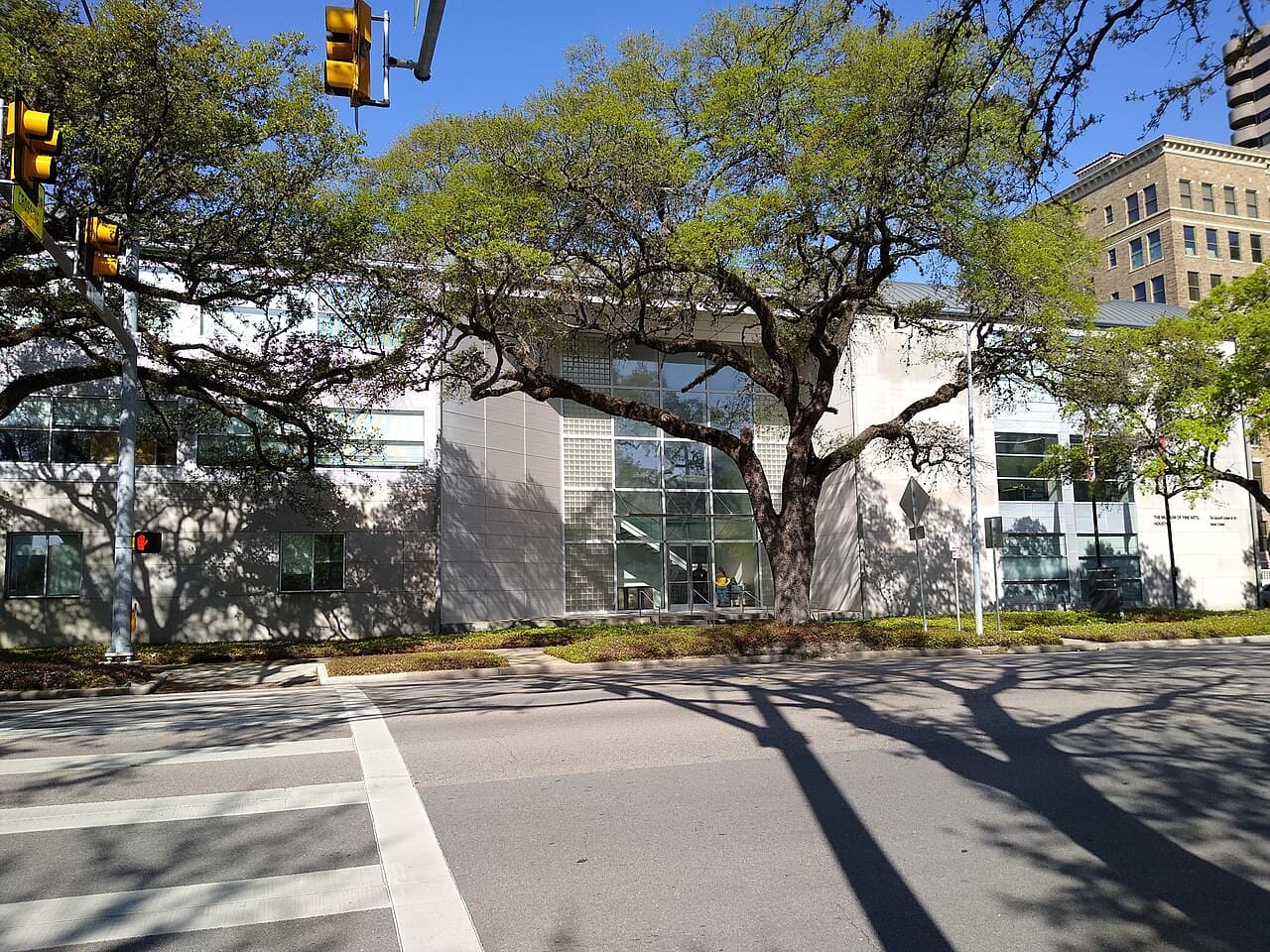
Start in Houston. The MFAH's Latin American Art Department was established in 2001 under the curatorial leadership of Mari Carmen Ramirez — who was, at the Blanton Museum at UT Austin from 1989 to 2000, the first curator of Latin American art appointed at any U.S. museum. She built the department from scratch, and over 25 years it has acquired more than 800 works spanning modern and contemporary art from across the Americas. A quarter of the Nancy and Rich Kinder Building's collection is Latin American or Latino art. The department's research arm, the International Center for the Arts of the Americas, has digitized over 8,200 primary-source documents — letters, manifestos, articles, exhibition reviews — from 16 cities across the hemisphere. No other American museum has invested at this scale. Our profile of Houston's quiet claim as the capital of Latin American art in the U.S. lays out the full argument.
In San Antonio, the San Antonio Museum of Art houses the Nelson A. Rockefeller Center for Latin American Art — three stories, 30,000 square feet, eight gallery spaces, approximately 10,000 works spanning nearly 4,000 years. In 2026, the museum added over 200 objects, including a gift of 60-plus works on paper by major 20th-century Mexican artists from Drs. Ricardo and Harriett Romo and 103 Mexican textiles collected during 1970s fieldwork in Nahua communities in Puebla. The collection is organized from pre-Columbian through colonial through modern and contemporary, and its depth in Latin American popular art is particularly strong.
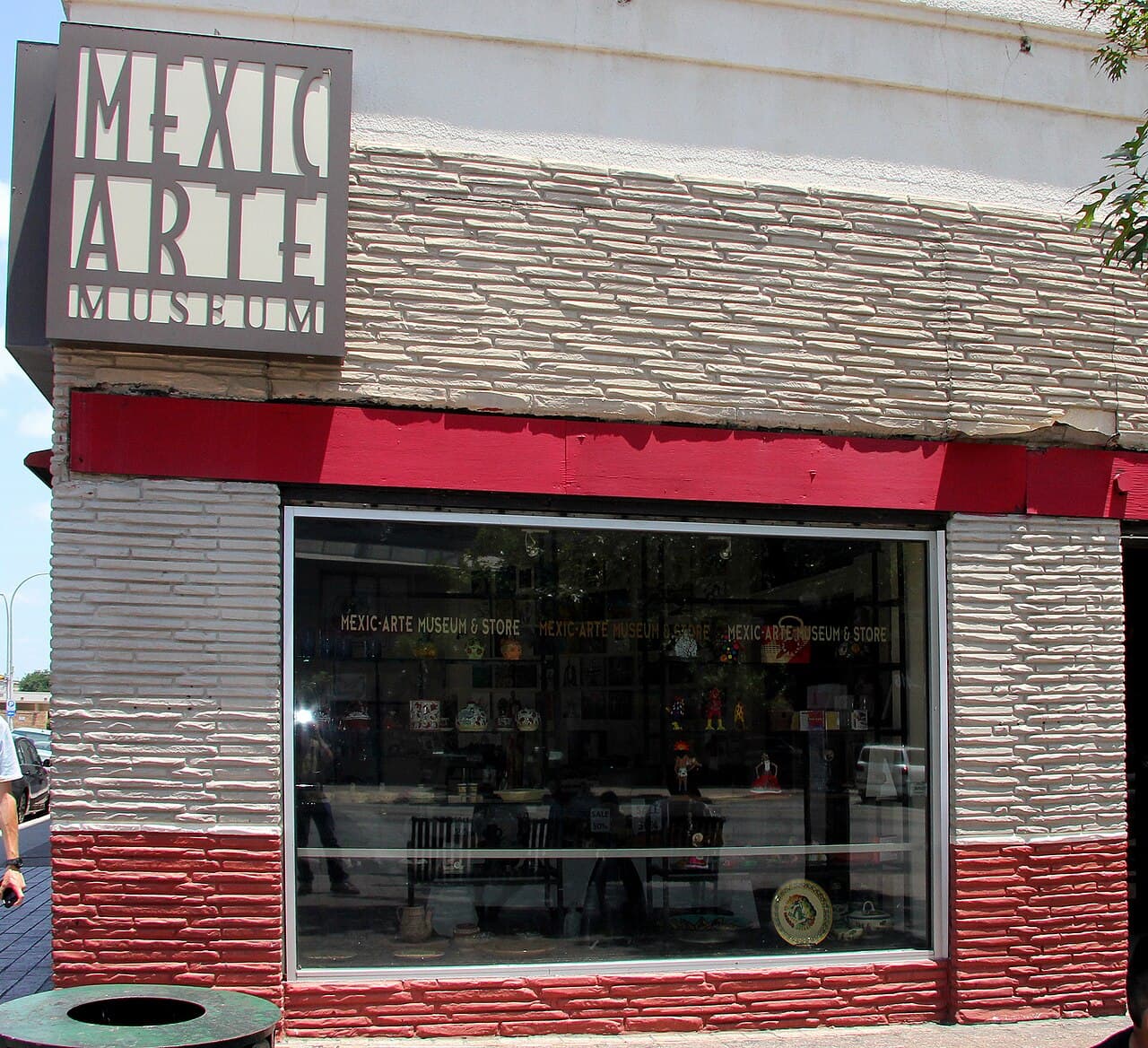
In Austin, the Mexic-Arte Museum has been the official Mexican and Mexican American Fine Art Museum of Texas since 1984. Founded by artists Sylvia Orozco, Sam Coronado, and Pio Pulido in a downtown warehouse, it moved to 419 Congress Avenue in 1988 and has drawn over 75,000 annual visitors — more than half of them people of color. The museum is currently relocated to the Austin History Center at 810 Guadalupe Street while a $14 million expansion replaces its Congress Avenue building with a four-story, 30,000-square-foot museum. The 43rd annual Viva La Vida Dia de los Muertos Festival and Parade — the largest and longest-running in Austin — happens in October, with six monumental skull sculptures installed along 5th Street by Mexico City's Colectivo Ultima Hora.
## San Antonio: Where It Started
The Chicano art movement in Texas was born in San Antonio, and the city has never relinquished that ground. In 1967, a group of Mexican American artists formed one of the earliest Chicano art collectives in the country. By 1972, they had reorganized as Con Safo — named after the expression painted on murals to demand respect — with members including Mel Casas, Felipe Reyes, Carmen Lomas Garza, Santa Barraza, Cesar Augusto Martinez, Kathy Vargas, and Amado Pena Jr. The group disbanded by 1974, but the artists it produced went on to define Chicano art nationally.
The murals followed. The Community Cultural Arts Organization, city-funded and established in 1979, produced over 200 murals by 1992 at public-housing projects across the Westside. San Anto Cultural Arts, co-founded in 1993 by Cruz Ortiz, Manny Castillo, and Juan Miguel Ramos, continued the tradition. Today, 53 murals line the Westside — start along Fredericksburg Road and around the Guadalupe Cultural Arts Center on South Brazos Street.
The center itself, founded in 1980, is one of the largest community-based multidisciplinary Chicano, Latino, and Native American arts organizations in the country. It houses Jesse Trevino's "La Veladora" — a three-dimensional mosaic of the Virgin of Guadalupe projecting from the 40-foot-high building, crafted in vibrant red and gold ceramic tiles — the world's largest mosaic statue of the Virgin Mary.
## The Artists
Jesse Trevino died in 2023 at 76, but his legacy is written on the walls of San Antonio in a way that can't be overstated. Born in Monterrey, Mexico, raised on San Antonio's Westside, he was drafted into Vietnam and triggered a booby trap that cost him his right arm. He learned to paint left-handed. His first major work, "Mi Vida" (1971-72), was painted on his own bedroom wall. His "Spirit of Healing" at Christus Santa Rosa Hospital is the largest tile mural in the United States — 93 feet high, 43 feet wide, over 150,000 pieces of ceramic tile depicting an angel watching over a boy holding a dove. His "La Historia Chicana" (1974) at Our Lady of the Lake University was the first Chicano mural in San Antonio. The Smithsonian holds his oral history.
Cruz Ortiz is the connective tissue of the San Antonio art scene. Born in Houston in 1972, he co-founded San Anto Cultural Arts, spent 15 years as a public high school art teacher, completed an Artpace residency in 2005, and has shown at the Louvre, LACMA, and the San Juan Triennial. His bold screen prints, wheat-paste murals, and guerrilla AM radio broadcasts address the bicultural landscape of South Texas with a directness that never sacrifices visual sophistication. In 2014, he designed the Absolut Texas limited-edition vodka bottle — a cosmic caballero cowboy boot stepping into a stylized landscape. His work is in the collections of Ruby City, the Smithsonian National Portrait Gallery, and the San Antonio Museum of Art.
Vincent Valdez, born in San Antonio in 1977, now working from Houston, is arguably the most nationally visible Texas-based Latinx artist of his generation. "The City I" (2015-2016) is a 30-foot-long black-and-white painting of 14 hooded KKK members — including a baby — at night, a late-model Chevy Silverado and a smartphone placing the scene firmly in the present. The Blanton Museum of Art acquired it, waited a year to unveil it, and it became a national sensation. He's the 2025-2026 artist-in-residence for the ACLU of Texas. His work combines what critics have called "gritty yet lyrical hyper-realism" with a searing social conscience.
Ana Fernandez paints San Antonio. Moody, mysterious paintings of houses and buildings on the Southside that feel like portraits of the neighborhood itself. She's also the owner of Chamoy City Limits, a food truck selling tricked-out raspas. She completed an Artpace residency in 2018, creating frescoes on non-traditional surfaces — trash cans, truck mirrors. She's a Joan Mitchell Foundation grant recipient. She teaches part-time at Northwest Vista College. She is a true San Antonio original.
In Dallas, Carlos Donjuan blends academic painting with raw graffiti energy — large-scale works influenced by hip hop, lowrider culture, and Mexican and Indigenous folk art. Born in San Luis Potosi, Mexico, raised in Dallas since age 3, he co-founded the Sour Grapes collective with his brothers in Oak Cliff in 2000. His work is in the Cheech Marin Collection — now its own museum in Riverside, California, the largest Chicano art collection in the country. He teaches drawing and painting at UT Arlington and has contributed to Meow Wolf.
## What's Happening Now
"Soy de Tejas: A Statewide Survey of Latinx Art," curated by Rigoberto Luna and Janelle Esparza of Presa House Gallery, brought together over 100 artworks by artists from seven Texas regions and 15 cities. It originated at Centro de Artes in San Antonio, traveled to Arts Fort Worth, and showed at the Cheech Marin Center in Riverside through January 2026. Luna — the first San Antonio native to serve as Artpace guest curator — curates Artpace's Fall 2026 residency cycle.
"Let Us Gather in a Flourishing Way" at the Buffalo AKG Art Museum features roughly 70 recent works by 58 artists surveying contemporary Latinx painting nationally. It's on view through September 6 and traveling to Des Moines, Denver, Phoenix, and Seattle. Vincent Valdez is in it.
At Ruiz-Healy Art in San Antonio, Eva Marengo Sanchez has her first solo gallery show (through August 22). At Artpace, the Spring 2026 cycle included Venezuelan-born Houston artist Violette Bule, whose installation "Hydra" addresses migration, identity, and the politics of space. At Ruby City, Tracey Rose's survey runs through May 2027, and Daniel Rios Rodriguez — a San Antonio native — has transformed the Studio space with site-specific paintings.
## Where to See It
Houston: MFAH Latin American galleries in the Kinder Building (always on view). Revolver Galeria on Peden Street for contemporary Latin American programming. RUBY Projects for curatorial exchanges with Mexico City.
San Antonio: Ruby City (free, Thursday-Sunday). Artpace (free). San Antonio Museum of Art (Rockefeller Center, three floors). Guadalupe Cultural Arts Center (Trevino's "La Veladora"). Ruiz-Healy Art. Contemporary at Blue Star (First Friday). The Westside murals (53 works, self-guided, always open).
Austin: Mexic-Arte Museum (temporarily at 810 Guadalupe during expansion). Viva La Vida Festival (October). "Las Calaveras de la Calle 5" skull installations (October through December).
Dallas: Carlos Donjuan's work at various Design District galleries. Sour Grapes collective murals. The Other Art Fair Dallas for emerging Latinx artists.
Hispanic Heritage Month runs September 15 through October 15. Dia de los Muertos follows. But the art is here all year — in the museums, on the walls, in the studios, and on the raspa truck. This is Texas. The story has always been here.