Project Row Houses: Rick Lowe's Houston Legacy
Project Row Houses turned shotgun houses into art. Rick Lowe's Third Ward legacy, explained.
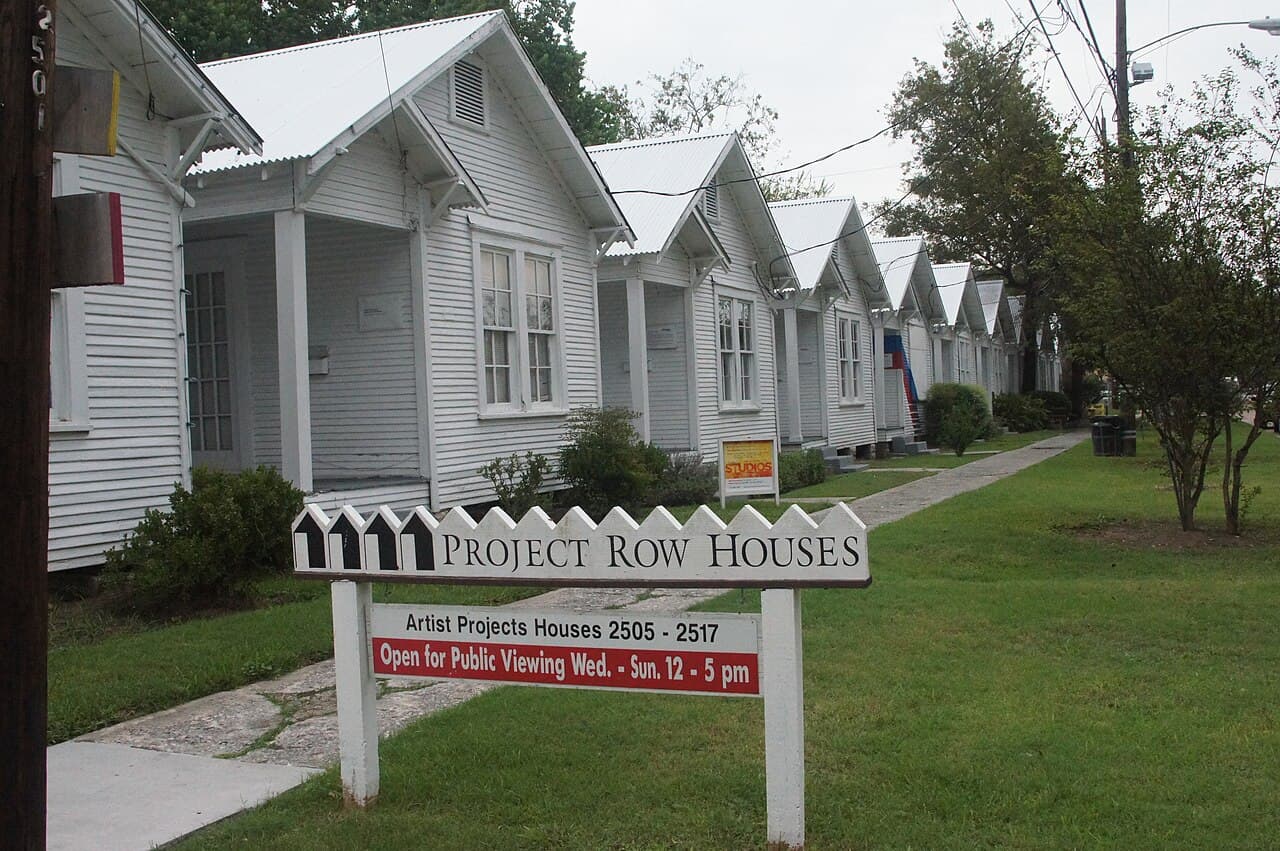
Hourick · CC BY 3.0
In 1993, a young Houston artist named Rick Lowe was reading John Biggers — the painter, muralist, and beloved TSU professor who had spent decades documenting the architecture and social life of Houston's Third Ward. Biggers painted shotgun houses. And Lowe, looking at those paintings, had a thought that would eventually earn him a MacArthur "genius" grant: what if the houses themselves could be art?
Lowe and six other artists — James Bettison, Bert Long Jr., Jesse Lott, Floyd Newsum, Bert Samples, and George Smith — acquired a block and a half of derelict shotgun houses on Holman Street. They didn't tear them down. They restored them. And then they did something radical: they turned them into art studios, gave the studios to visiting artists, and said the art that mattered most was the transformation of the neighborhood itself.
That was Project Row Houses. And thirty-three years later, it encompasses five city blocks, 39 structures, artist residencies, a housing program for young mothers, community gardens, small business incubators, and an annual calendar of exhibitions and events that draws artists and scholars from around the world. Glasstire has covered its programming continuously for two decades, and the institution consistently earns the kind of critical attention that puts it in the same conversation as much larger, better-resourced spaces.
The intellectual framework came from Joseph Beuys and his concept of "social sculpture" — the idea that art's highest purpose isn't objects in galleries but the shaping of society itself. Lowe took that European theory and grounded it in an African American neighborhood with a specific history, specific needs, and specific beauty. "A large part of my work," Lowe has said, "includes introducing poetic moments into mundane activities."
The model works like this: eight of the shotgun houses serve as rotating art studios, where visiting artists create work in response to African American themes and the neighborhood's history. Behind the art studios, another row of houses provides subsidized housing for single mothers pursuing education. Around the campus, community programs — after-school tutoring, micro-business support, health initiatives — are woven into the daily life of the block.
In 2014, the MacArthur Foundation awarded Lowe its fellowship — $625,000, no strings attached — in recognition of the fact that Project Row Houses had fundamentally changed the conversation about what art could accomplish in American cities. The model has been studied and adapted by communities from Detroit to Johannesburg.
But here's the thing about Project Row Houses that you can't understand from reading about it: you have to walk the block. You have to see the shotgun houses — small, wooden, painted in bright colors — lined up on a street where neighbors sit on porches and kids ride bikes. You have to step into one of the art studios and realize that you're looking at a work of art about a community, inside a house that is itself part of a work of art about community. The recursion is the point.
For visitors building a Houston art itinerary around it, the Third Ward sits between the Museum District's institutional core — CAMH, the MFAH, the Menil Collection — and the Washington Avenue corridor where Sawyer Yards anchors the city's working artist community. Our complete guide to Houston's art neighborhoods maps all of it.
Project Row Houses is located at 2521 Holman St in Houston's Third Ward. The campus is open to the public. Visit projectrowhouses.org for exhibition schedules and events.