Review: 'Town Meeting' at Art League Houston
Nick Vaughan and Jake Margolin's exhibition revisits the 1978 gathering of 4,000 LGBTQIA+ Houstonians at the Astro Arena — and asks what's changed since.
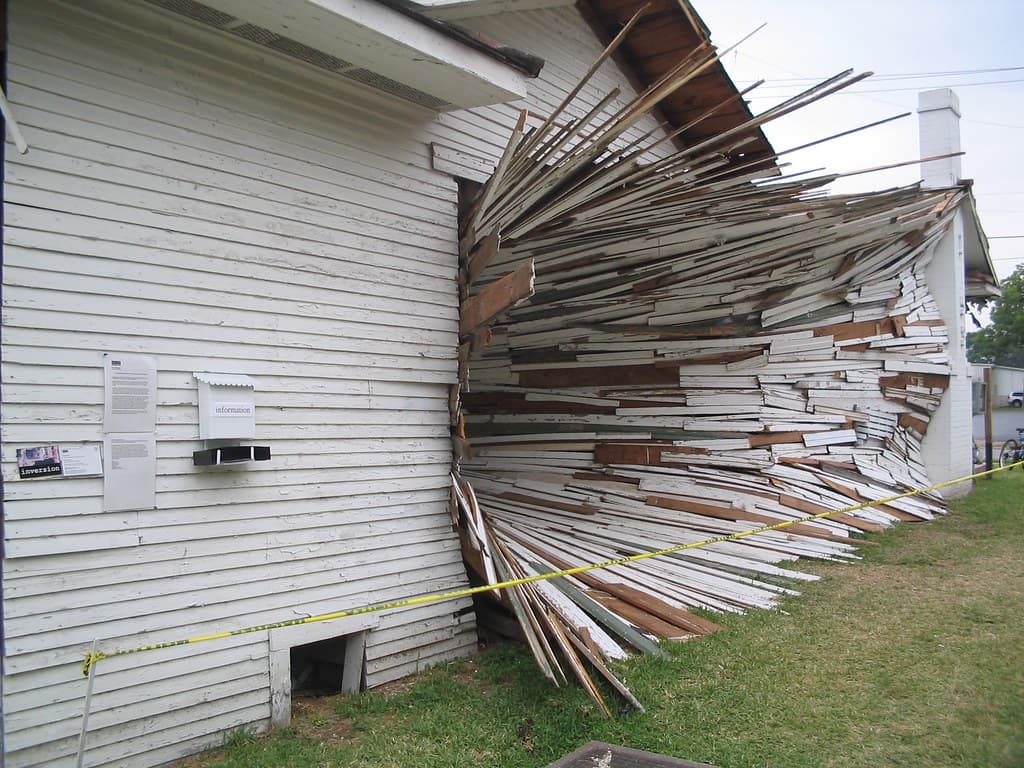
Nick Douglas · CC BY 2.0
In 1978, four thousand LGBTQIA+ Houstonians gathered at the Astro Arena for a Town Meeting — a direct response to Anita Bryant's anti-gay crusade and the broader conservative backlash sweeping the country. It was, at the time, one of the largest queer political gatherings in American history. And unless you've spent time in Houston's LGBTQ archives, you've probably never heard of it.
Nick Vaughan and Jake Margolin have. The Houston-based artist duo has spent years researching queer history through the lens of geography, mapping the physical spaces where LGBTQ communities have gathered, organized, and survived. Their previous work includes "50 States," a multi-year project that mapped sites of queer history and anti-queer violence across the entire country. "Town Meeting 1978-2028," on view at Art League Houston through July 20, is their most ambitious excavation yet — and it lands at an institution with the history and the community trust to hold it.
Art League Houston has been operating since 1948, making it one of the oldest community-based art organizations in Texas. The institution runs out of a building at 1953 Montrose Blvd that houses both exhibition galleries and classroom spaces, and its programming has always prioritized accessibility and community engagement over market positioning. The annual juried shows, the open-call exhibitions, the classes and workshops — these are the connective tissue that holds a neighborhood art scene together. Art League Houston doesn't chase blue-chip credentials. It serves artists and audiences at every level, and it has done so for more than 75 years.
The "Town Meeting" format is itself part of Art League Houston's identity. The institution has used this name for its periodic open-call exhibitions — shows where any artist can submit work around a shared theme — for decades. It is a deliberately democratic structure, rooted in the idea that art institutions should amplify voices rather than curate them into silence. Vaughan and Margolin's exhibition takes this format and repurposes it brilliantly: the "town meeting" of the title refers both to Art League Houston's exhibition tradition and to the literal 1978 political gathering that forms the show's historical center.
The exhibition centers on that 1978 gathering but spirals outward — into the bars, community centers, private homes, and public parks where Houston's queer community built itself in the decades before and after. Vaughan and Margolin work in video, installation, and archival material, and the show has the feeling of a documentary that refuses to stay flat on the screen. Projected footage of oral history interviews plays alongside printed ephemera from Montrose-era gay bars and community organizations. Sculptural elements made from found and constructed materials create spatial markers that function as both memorial and living history. A timeline installation traces the evolution of queer public life in Houston from the pre-Stonewall era through the AIDS crisis, the marriage equality fight, and the ongoing battles over trans rights.
What makes the work resonate beyond queer history is its treatment of Houston itself. This is a city that demolishes its own past with remarkable efficiency — buildings come down, neighborhoods transform, and the physical evidence of what happened in a place disappears. The bars where queer Houstonians gathered in the 1970s are condos now. The community centers are parking lots. The physical geography of survival has been erased by development, and the only record that remains is in the memories of the people who were there and the archives they've managed to protect.
Vaughan and Margolin's project is fundamentally about that disappearance, and about the effort required to remember what a city would prefer to forget. The 1978 Town Meeting was not a pride parade or a protest — it was four thousand people showing up in a sports arena to say, publicly and collectively, that they existed. That the gathering happened in Houston — a conservative, Southern, sprawling city that was not supposed to be a site of radical queer organizing — makes it historically significant. That almost no one remembers it makes the artistic excavation necessary.
The show also raises productive questions about what community-driven exhibitions can accomplish that institutional shows cannot. Art League Houston's willingness to give Vaughan and Margolin the entire gallery, to let them build an environment rather than simply hang work on walls, reflects the kind of trust that develops between an institution and its community over decades. This is not a show that could have been parachuted in from outside.
Art League Houston is at 1953 Montrose Blvd, Houston, TX 77006. "Town Meeting 1978-2028" runs through July 20. Admission is free. For more on Montrose's gallery scene, see our neighborhood guide.